
Learn how to define project requirements and align them with business needs.
Table of Contents
What Are Project Requirements?
Project requirements are the basis of a successful project. They outline what the project must deliver, what users and stakeholders expect, and what conditions must be met for the project to be considered successful. When requirements are unclear, incomplete, or disconnected from business objectives, a project can face scope creep, budget overruns, delays, rework, stakeholder dissatisfaction, and poor business outcomes. So, the key is to ensure every important requirement is connected to a real business need.
Why Is It Important to Align Project Requirements with Business Needs?
A project can technically deliver everything specified in its plan and still fail if those requirements do not solve the organization’s actual problem. Aligning requirements with business needs helps organizations,
- Focus on valuable project outcomes
- Avoid unwanted features
- Reduce project costs
- Reduce rework
- Improve stakeholder satisfaction
- Control project scope
- Support better-decision making
- Enhance the likelihood of project success
How to Define Project Requirements and Align them with Business Needs
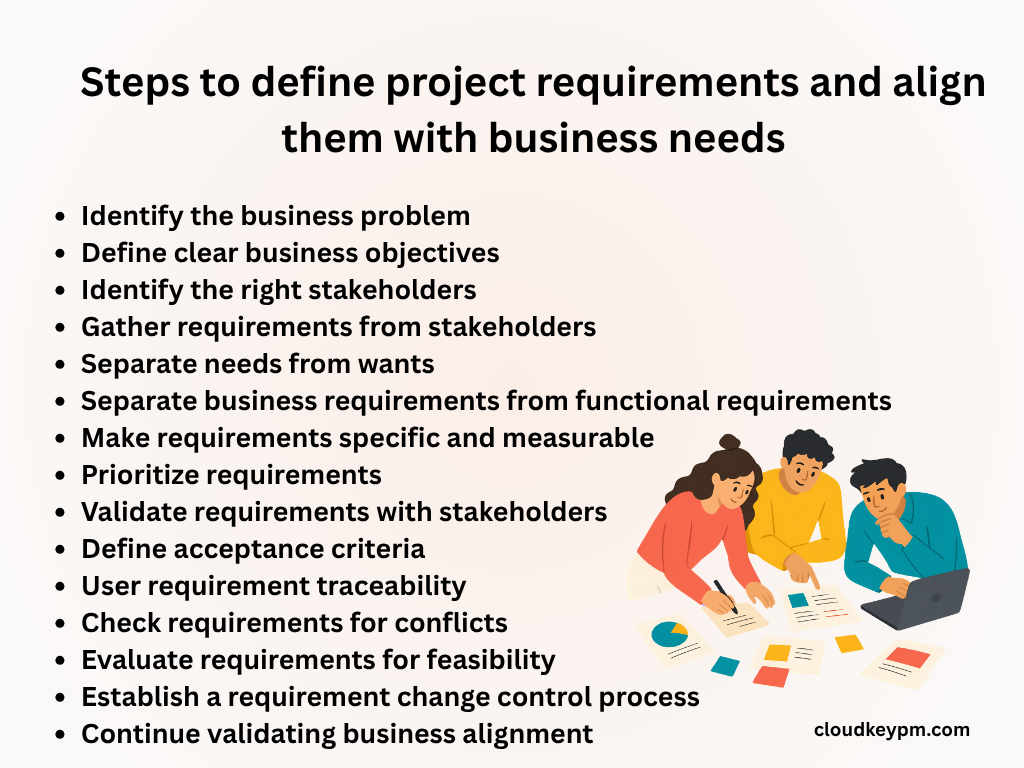
Here are the key steps for defining project requirements and aligning them with business needs.
Identify the Business Problem
Before collecting detailed requirements, understand the problem the project is expected to solve. As a project manager, you can ask questions such as,
- What problem exists today?
- Who is affected by the problem?
- What is causing the problem?
- How much does the problem cost the organization?
- What happens if the problem is not solved?
- What improvement does the business expect?
For example, ABC company needs a new inventory system, but the project team might discover that the actual business problem is ‘ the company is losing sales because inventory information is not updated accurately’. This understanding creates a much stronger foundation for defining requirements.
Define Clear Business Objectives
Once the problem is understood, establish measurable business objectives. A business objective might be:
‘Reduce inventory-related order errors by 30% within six months of implementing the new system.’ This objective provides direction for the requirements. As a result, the project team can determine which capabilities are actually necessary to achieve these results.
| Business objective | Requirement | Deliverable | Measurament |
| Reduce inventory error by 30% | The system must update inventory quantities automatically after each confirmed sale | Automated inventory management functionality | Compare inventory error rates before and after implementation |
Identify the Right Stakeholders
Stakeholders provide valuable information about business needs and project expectations. Depending on the project, stakeholders may include:
- Project sponsor,
- Project manager,
- Business owners,
- Customers,
- End users,
- Department managers,
- Finance team,
- Technical team,
- Operations system,
- Suppliers, etc.
Each stakeholder may view the project differently. For example, a customer may want a simple user experience, while the finance department may be more concerned with cost and reporting. However, a strong requirements process considers these different perspectives.
Gather Requirements from Stakeholders
As a project manager, you can use several techniques for gathering requirements, including interviews, workshops, surveys, observation, document analysis, and prototyping. Using multiple techniques often produces better results than relying on a single technique.
Separate Needs from Wants
Stakeholders sometimes describe a solution instead of the underlying business need. For example: ABC company needs a mobile application, but instead of immediately accepting this as a requirement, ask why. Perhaps the answer is “ Customers need to check their order status while away from their computers.” Now the project team understands the actual need.
The final solution might be a mobile application, but it could also be a responsive website, SMS notification system, or another solution. This approach prevents the project from becoming unnecessarily focused on a predetermined solution.
- Separate business requirements from functional requirements
Knowing the different types of requirements makes documentation clearer. For example;
| Business requirements | User requirements | Functional Requirements | Non-functional requirements |
| Explain why the project is needed“Increase online customer orders by 20%” | Explain what users need to accomplish“Customers need to search products and place orders online” | Explain what the solution must do“The system must allow customers to add products to a shopping cart” | Describe qualities or performance expectations“This can include security, performance, reliability, availability, usability, scalability” |
Make Requirements Specific and Measurable
Poor requirements often use vague language. For example: “The computer system should be secure.” This is difficult to measure. A better requirement would be, “The computer system must require multi-factor authentication for administrator accounts.” Specific requirements are easier to develop, test, approve, and manage.
Prioritize Requirements
Not every requirement is equally important. Therefore, prioritize requirements based on business value, customer impact, risk, regulatory requirements, cost, urgency, dependencies, and technical feasibility. A simple classification could be:
| High | Essential to achieve the business objectives |
| Medium | Valuable but not critical |
| Low | Useful but can be postponed |
Validate Requirements with Stakeholders
After requirements are documented, stakeholders should review them. However, validation helps answer:
- Is the requirement correct?
- Is anything missing?
- Is the requirement realistic?
- Does it support the business objective?
- Can it be tested?
- Is everyone clear on it?
Therefore, it is important to get approval early, because correcting a misunderstanding during requirements definition is usually much easier than correcting it after development has started.
Define Acceptance Criteria
Acceptance criteria define the conditions that must be met for a requirement to be accepted. For example:
| Requirement | Acceptance criteria |
Customers must be able to reset their passwords online | Customer can request a password resetA secure reset link is sent to the registered email addressThe reset link expires after a defined periodThe customer can create a new passwordThe customer receives confirmation after the password is changed |
Acceptance criteria make requirements testable and help minimize disagreements between the project team and stakeholders.
User Requirement Traceability
A requirements traceability matrix can help link requirements to business objectives and project deliverables. An example of a simple structure could include.
| Business objective | Requirement | Deliverable | Acceptance criteria | Status |
| Minimize processing time | Automate approvals | Approval workflow | Approval completed electronically | In progress |
| Enhance customer service | Online support request | Support portal | Customer can submit a request | complete |
| Minimize errors | Automated validation | Validation feature | Invalid data is rejected | In progress |
This matrix helps to determine whether the project is actually contributing to the business goal.
Check Requirements for Conflicts
Different stakeholders may have conflicting expectations. For example, the customer wants more features, finance wants lower costs, operations wants simplicity, security wants stronger controls, and management wants faster delivery. As a project manager, you should identify these conflicts early and work with stakeholders to establish priorities and acceptable trade-offs. However, ignoring conflicts can result in major problems later in the project.
Evaluate Requirements for Feasibility
A requirement may be desirable but unrealistic. Before accepting the project, the project manager should consider these factors.
| Technical feasibility | Finance feasibility | Schedule feasibility | Resources feasibility | Legal and regulatory feasibility |
| Can the technology support it? | Can the organization afford it? | Can it be delivered within the required timeframe? | Does the organization have the required skills and resources? | Does the requirement comply with applicable rules? |
A requirement should deliver value without creating unacceptable cost, risk, or complexity.
Establish a Requirement Change Control Process
Business requirements may change during a project. However, uncontrolled changes can lead to scope creep. Therefore, every significant change should be assessed for its impact on project triple constraints and existing requirements. For example:
Requested change → Business justification → Impact analysis → Stakeholder approval → Requirement update → Project plan update
Continue Validating Business Alignment
Requirements should not be reviewed only at the start of the project. Business priorities can change because of market conditions, customer expectations, new technology, competition, organizational strategy, or regulatory changes. However, regular review helps ensure that the project continues to solve the right problem.
Conclusion
Correctly defining project requirements is about more than listing features. It means understanding what the business is trying to achieve and making sure every key project requirement supports that goal. When project managers identify the real business problem, engage stakeholders, document clear requirements, prioritize business value, define acceptance criteria, maintain traceability, and control changes, they can greatly reduce project risk and increase the likelihood of delivering meaningful results.