Learn how to prepare for the PMP certification exam, including exam tips and essential resources that help you pass on your first attempt.
Table of Contents
How to Prepare for the PMP Certification Exam
The Project Management Professional (PMP) certification is among the most valuable credentials in project management. Earning the PMP demonstrates your ability to lead projects, manage teams, and deliver successful outcomes using globally recognized project management practices.
However, the PMP exam is the most challenging and requires thorough preparation. With the right study plan, resources, and exam strategy, you can significantly increase your chances of passing on your first attempt. Let’s discuss how to prepare for the PMP certification exam from start to finish.
Understand the PMP Exam Requirements
Before you begin studying, ensure you meet eligibility requirements for the PMP exam. According to the PMI, you must require,
- Secondary degree and a minimum of five years of project management experience, or
- Four-year degree and a minimum of three years of project management experience, or
- Bachelor’s or post-graduate degree from a GAC-accredited programme and minimum two years of project management experience
If you haven’t yet met these requirements, gain the necessary experience and training before applying.
Read More: Discussion Forums for the PMP Exam
Learn the PMP Exam Format
As discussed earlier, if you have met the requirements, you can now prepare for the PMP exam. Understanding the PMP exam format or structure helps you prepare more effectively. According to the PMI, the PMP exam consists of:
- 180 questions
- A time limit of 230 minutes
- Three domains (people, process, business environment)
This exam tests your knowledge of predictive, agile, and hybrid project management approaches.
Study the Exam Content Outline
The PMP exam content outline explains exactly what knowledge and skills are tested. Then review each domain carefully. Read more: PMP examination content outline PDF.
Create a Study Plan
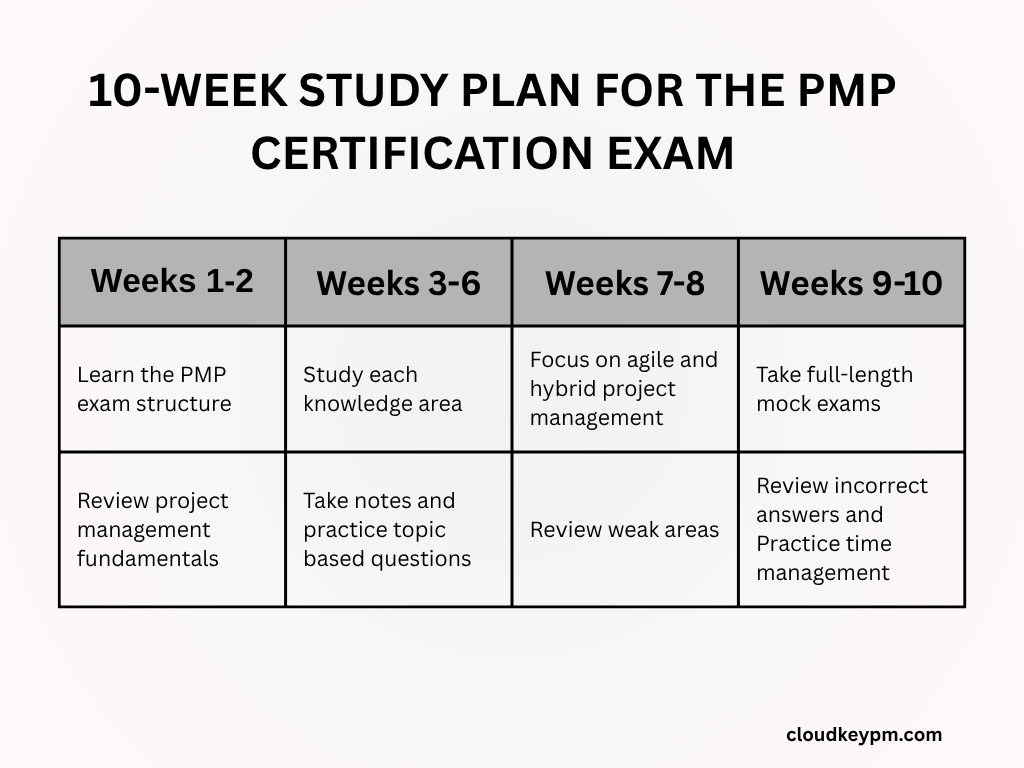
Creating a PMP exam study plan helps you manage your time more effectively. However, maintaining consistency is more important than occasionally studying for long hours. Here is a sample of a 10-week study plan, as pictured.
Study the PMBOK Guide
The PMBOK (Project Management Body of Knowledge) guide is one of the primary references for the PMP exam.
Mr. Prem Monis (Program Manager at Global Relay) emphasizes that “when answering scenario-based questions, you should apply your experience as a manager in alignment with the PMBOK. For theoretical and math questions, you need to know the definitions of processes, tools, and techniques, a few key terms, and project management formulas, which you will find in the latest PMBOK edition”.
Although the exam isn’t solely based on the PMBOK guide, it covers essential project management concepts, terminology, and best practices that every PMP candidate should understand. However, don’t try to memorize every page; instead, understand how the concepts work together in real project situations.
Read More: PMI Launches the PMBOK 8 Edition | Comparison with PMBOK 6th and 7th Edition
Learn Agile Project Management
Modern PMP exams include a significant number of agile and hybrid questions. Understand concepts such as Scrum, Kanban, Product backlog, Sprint planning, Agile roles, Daily stand-ups, and Retrospectives.
Focus on Scenario-Based Questions
Most PMP questions present real-world project situations rather than asking for simple definitions. When answering, the following should be considered.
- Read the entire scenario carefully
- Eliminate obviously incorrect answers
- Identify the project phase
- Determine your role as the project manager
- Select the option that best follows PMI’s recommended practices
Use a Reliable PMP Exam Preparation Course
Many candidates benefit from a structured PMP exam preparation course. A quality course helps you understand difficult concepts, learn exam strategies, practice scenario-based questions, and stay organized with a study schedule.
Practice with Mock Exams
Practice exams are the most effective preparation tools. Mock exams help you build confidence, improve speed, identify weak topics, become familiar with question wording, and develop exam endurance.
Review Weak Areas
As your exam date approaches, spend more time reviewing the topics where you score lowest. This also helps you improve your knowledge.
Prepare for Exam Day
As a PMP exam candidate, a few days before the exam, ensure you get enough sleep, refrain from studying entirely new topics, review essential formulas and concepts, verify your exam appointments, and gather the necessary identification documents.
Conclusion
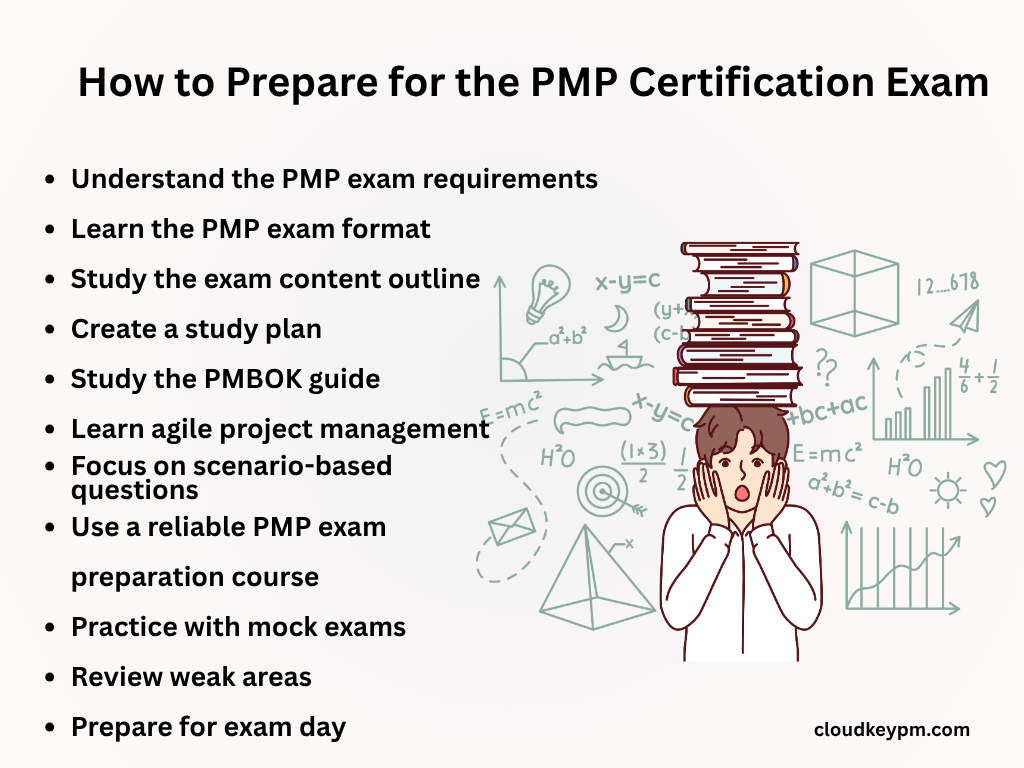
When preparing for the PMP certification exam, a candidate should follow these steps: understand the PMP exam requirements, learn the PMP exam format, study the exam content outline, create a study plan, study the PMBOK guide, learn agile project management, focus on scenario-based questions, use a reliable PMP exam preparation course, practice with mock exams, review weak areas, and prepare for exam day.