
Confused about PMP and PMI? Discover the difference between PMP and PMI and how PMI’s PMP certification can advance your project management career.
Table of Contents
Difference Between PMP and PMI
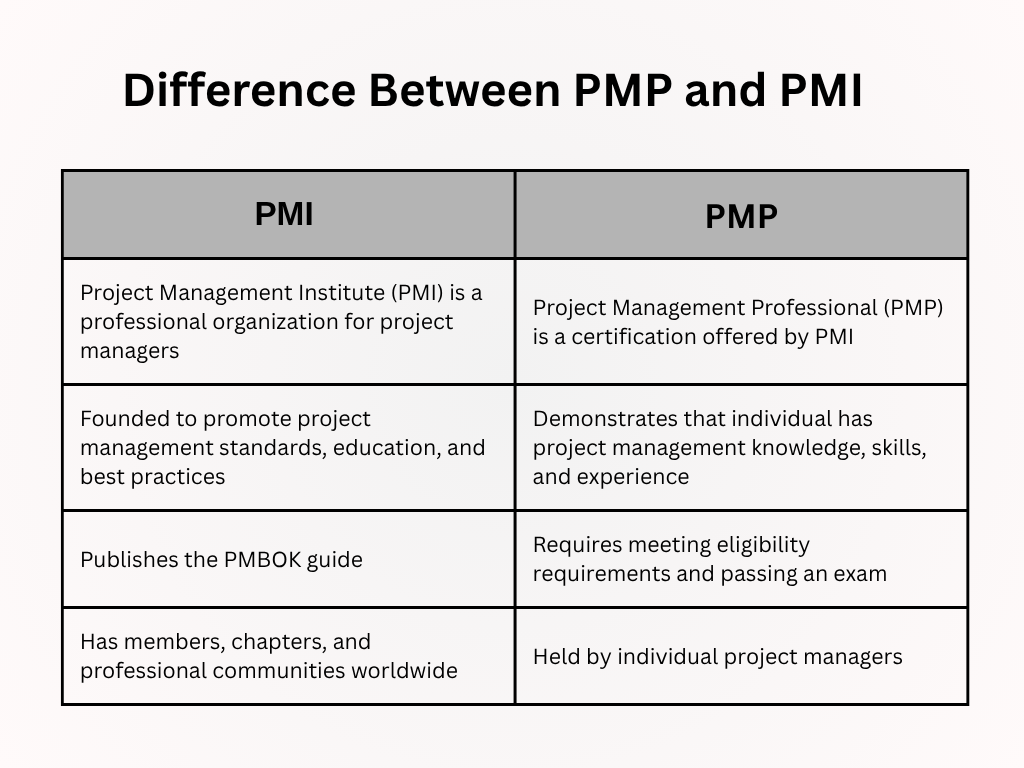
In short, PMI is an organization, and PMP is one of its certifications.
What Is PMP?
The PMP (Project Management Professionals) certification is PMI’s flagship credential. It validates a professional’s ability to lead and manage projects, apply predictive, agile, and hybrid approaches, manage project teams and stakeholders, and deliver successful project outcomes.
What Is PMI?
PMI (Project Management Institute) is a global organization that supports project management professionals through standards and frameworks, certifications, training and education, research and publications, and professional networking opportunities.
Read More: PMI Launches the PMBOK 8 Edition
FAQs
Do Project Managers Need to Know PMBOK?
Yes, project managers should be familiar with PMBOK, especially if they aim to adhere to industry best practices or pursue a PMP certification. Additionally, if an organization follows the PMBOK, having knowledge of it is beneficial. New project managers will find it very helpful. However, it is important to remember that PMBOK serves as a guideline, not a strict rule.
Is the PMBOK Guide Published in Languages other than English?
Yes, the PMI publishes the PMBOK in several languages beyond English, translating the guide to make it accessible to project management professionals worldwide. The translations vary by edition and often include languages such as:
- Arabic
- Chanise (Simplified, PRC)
- Chanise (Traditional, Taiwan)
- French (France)
- German (Germany)
- Japanese (Japan)
- Korean (Koriea)
- Portuguese (Brazil)
If you are a PMI member, you can now download PMBOK through the PMI website.
Can Pass PMP Without Reading PMBOK?
Yes, it is possible to pass the PMP exam without reading the entire PMBOK guide, but it’s not generally recommended because it depends on the individual. Based on your experience, PMBOK would help you clear many aspects. However, having at least a working knowledge of the PMBOK guide will make preparation easier and help you better understand PMI’s project management frameworks.
Therefore, I suggest you at least try to study the PMBOK because it is the primary reference.
Read More: Top 4 Online Project Management Professional (PMP) Training Sites
Can I Become a Skilled Project Manager just by Reading the PMBOK Guide?
No, reading the PMBOK guide alone is usually not enough to become a skilled project manager. The PMBOK is an excellent reference, but project management is a practical discipline that requires both knowledge and experience.
The PMBOK guide can help you learn project management principles, the project life cycle, project performance domains, including scope, schedule, finance, stakeholder, resources, and risk. Furthermore, you can learn inputs and outputs, tools and techniques, procurement, and artificial intelligence. However, the PMBOK guide cannot fully develop skills such as
- Leadership,
- Team management,
- Negotiation,
- Conflict resolution,
- Communication,
- Decision-making under pressure, and
- Managing stakeholders.
Only these skills can be developed through real project experience, mentoring and coaching, case studies, and working with project teams.
Therefore, the best way to learn project management is to combine PMBOK knowledge with practical experience, training, and real project work.
Does PMP Certification Add any Value Nowadays?
Yes, PMP certification still adds significant value today, although its value depends on your career goals, industry, and level of experience. Furthermore, it gives you global recognition, demonstrates professional competence, improves job opportunities, increases earning potential, and provides structured earning potential.