
Discover essential project management tips every project manager should know | part 3
Table of Contents
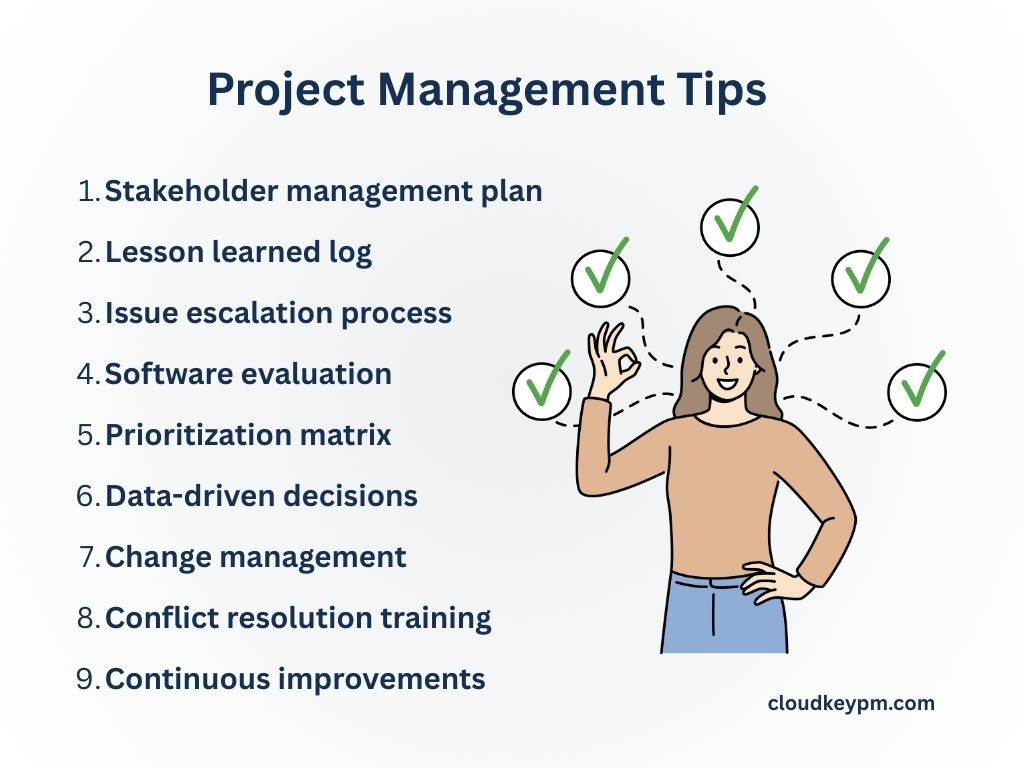
Project Management Tips
Read More: Project Management Tips Every Project Manager should Know |Part 1 and Part 2
Stakeholder Management Plan
Effective project management necessitates a comprehensive stakeholder management plan. This crucial document serves to identify, understand, and appropriately engage all individuals or groups interested in the project’s outcome. By clearly defining stakeholder expectations, optimal communication channels, and required involvement levels, project managers gain the ability to proactively mitigate potential risks and resolve conflicts. Ultimately, a well-executed plan cultivates open communication, establishes trust, and ensures stakeholders are aligned with the project’s overarching objectives.
Effective stakeholder management is crucial for project success, significantly increasing the probability of on-time delivery, adherence to budget, and satisfaction among all participants. Ultimately, this contributes to greater organizational value and the achievement of project objectives.
Lesson Learned Log
A lesson learned log is essential for fostering organizational growth and enhancing project execution. It acts as a vital historical record, capturing both successes and failures to preserve knowledge for future endeavors. This documentation helps prevent the recurrence of mistakes, enabling teams to learn from past experiences and thereby avoid expensive errors. Furthermore, the log highlights successful best practices and innovative methods that can be consistently applied across different projects.
A lessons learned log is essential for cultivating a culture of continuous improvement, encouraging teams to actively reflect, analyze, and adapt. Ultimately, this practice enhances project efficiency, results in higher quality deliverables, and contributes significantly to overall organizational success.
Issue Escalation Process
Effective project management requires a vital issue escalation process. This structured approach is essential for resolving problems and addressing issues that emerge throughout a project’s lifecycle.
An escalation process is crucial for effective project management. By clearly defining roles and escalation paths, it guarantees prompt decision-making and intervention, which prevents minor problems from becoming major crises. This proactive approach safeguards project deadlines and objectives. Furthermore, it demonstrates accountability and a commitment to problem-solving. A well-defined escalation process also protects project resources by concentrating efforts on critical issues and minimizing unnecessary delays.
Ultimately, it contributes to overall project success by reducing disruptions and maintaining stakeholder confidence.
Software Evaluation

Software evaluation is a crucial component of project management because it is necessary to ensure that the chosen tools effectively align with both project goals and requirements.
Project managers should compare various software options to determine the optimal choice based on features, cost, and ease of use. This careful evaluation is crucial for minimizing the financial risk associated with adopting tools that fail to align with project objectives. Furthermore, selecting the right software helps optimize resource allocation by choosing tools that improve workflows and boost overall productivity.
Ultimately, this provides the essential technological foundation for the project, enabling it to achieve its objectives and deliver the desired outcomes, thus contributing to overall project success.
Prioritization Matrix
Effective project management relies on a prioritization matrix. This tool offers a structured method for evaluating and ranking competing projects or tasks according to established criteria.
A prioritization matrix is a valuable tool for project managers, enabling data-driven decisions regarding resource allocation and project sequencing. By visually comparing project characteristics—such as impact, urgency, and resource needs—managers can optimize resource utilization, focus efforts on high-value initiatives, and effectively mitigate risks. Furthermore, this matrix enhances communication and transparency with stakeholders by clearly outlining the rationale behind project decisions.
Ultimately, it contributes to overall project success by ensuring that limited resources are allocated to the most impactful projects.
Data-Driven Decisions
Successful project management hinges on data-driven decision-making. Project managers enhance project outcomes, optimize resource allocation, and mitigate risks by relying on factual information instead of assumptions or intuition.
Leveraging data is crucial for gaining valuable insights into a project’s performance. It helps in identifying trends, bottlenecks, and specific areas for improvement, allowing for proactive adjustments to project plans and strategies to ensure project goals are met. Furthermore, grounding decisions in evidence, rather than mere opinion, promotes accountability and transparency within the decision-making process.
Ultimately, it contributes to overall project success by reducing uncertainties and enhancing the likelihood of achieving desired results.
Change Management
Change management is crucial in project management as it ensures a smooth transition from the project’s current state to its desired future. Projects are inherently dynamic, with evolving requirements, technological advancements, and unforeseen challenges.
In project management, effective change management is essential for successfully transitioning from the current state to the project’s desired future. This is because projects are naturally fluid, often involving evolving requirements, new technologies, and unexpected obstacles.
To ensure project success and minimize disruption, effective change management is crucial. This involves proactively anticipating, assessing, and addressing modifications. Key components include robust communication, active stakeholder engagement, and developing strategies to overcome resistance to change. By adopting this proactive approach, project managers can maintain momentum, mitigate risks, and successfully achieve project outcomes.
Conflict Resolution Training

Effective conflict resolution training is crucial for project managers, given the inherent complexities and pressures of project environments. Since conflicts are unavoidable when diverse individuals work together on shared objectives, providing project managers with these skills is vital. Such training empowers them to proactively manage disagreements, misunderstandings, and interpersonal tensions, preventing escalation. This ultimately boosts communication and collaboration while preserving team morale. The training teaches project managers how to pinpoint the origins of conflict, recognize various conflict styles, and implement suitable resolution strategies.
Ultimately, conflict resolution training motivates project managers to create a positive and productive work environment, leading enhanced project outcomes.
Continuous Improvements
Continuous improvement is a cornerstone of effective project management, vital for boosting efficiency and achieving greater success. When project teams cultivate a mindset of ongoing learning and adaptation, they become adept at spotting areas for enhancement, minimizing waste, and streamlining operations. This cyclical process yields significant benefits, including higher productivity, lower expenses, and greater satisfaction among stakeholders. Furthermore, by embracing continuous improvement, project managers can elevate project methodologies, fortify risk management strategies, and foster stronger collaboration within the team.
This dedication to continuous improvement ultimately guarantees that projects yield outstanding outcomes and advance the organization’s long-term objectives.
Conclusion
Project management tips such as stakeholder management plan, lesson learned log, issue escalation process, software evaluation, prioritization matrix, data-driven decisions, change management, conflict resolution training, and continuous improvements are essential for every project manager because they are crucial to project success.